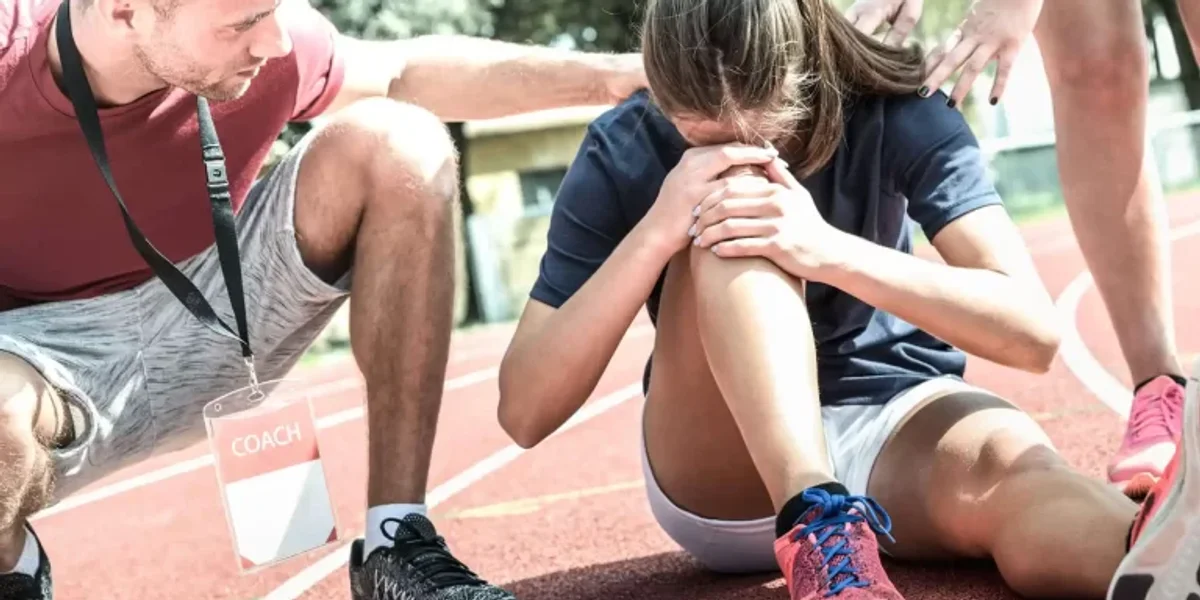
Growing bodies are more prone to certain injuries, especially during growth spurts. Knowing the signs keeps your child active.
Understanding common injuries, how to manage them and how to prevent them helps children stay healthy and confident.
Early rest is the key to a full recovery.
Three common overuse injuries
- Osgood-Schlatter disease (knee). Pain and swelling below the knee, worse after sport. It affects about 1 in 10 adolescents (Chandra et al., 2024). Reduce painful activity, ice and stretch. It usually settles as growth slows.
- Sever’s disease (heel). Heel pain, limping or walking on tiptoes. Rest from high-impact activity, ice, and use cushioned footwear or heel pads. It settles once growth is complete.
- Little League elbow. Inner elbow pain, swelling and stiffness from lots of throwing (cricket, baseball, javelin), typically aged 8 to 15. Rest from throwing, ice and get regular check-ups.
Sprains and strains
- Sprain. A stretched or torn ligament, most often in the ankle or knee. “I’ve rolled my ankle.”
- Strain. Stretched or torn muscle or tendon, such as the hamstring, thigh or back. “I’ve pulled my hamstring.”
- Recovery. Most improve within about two weeks. Avoid high-impact activity such as running for up to eight weeks. Severe cases may need a physiotherapist.
The R.I.C.E. method (NHS)
- Rest. Avoid activity that causes pain.
- Ice. 15 to 20 minutes every 2 to 3 hours.
- Compression. Use bandages if advised.
- Elevation. Raise the area to reduce swelling.
Reduce the risk
- Warm up and cool down
- Play a variety of sports
- Wear the right protective kit
- Prioritise rest and recovery
- Support hydration and nutrition
See a healthcare professional if pain persists, your child is limping or swelling gets worse. I’m not a qualified physiotherapist or doctor, but my degree and years of coaching and playing have given me valuable insight.
How BHSports can help
If a child is managing an injury, we offer recovery tips and suitable low-impact activities during the day. Our programmes focus on age-appropriate training, variety, rest and safe, modified activities.
References
- Adirim, T.A., Cheng, T.L. (2003). Overview of injuries in the young athlete. pubmed.ncbi.nlm.nih.gov/12477379
- Chandra, R. et al. (2024). Diagnosis and management of Osgood-Schlatter disease. pmc.ncbi.nlm.nih.gov/articles/PMC11262732
- Krause, B.L., Williams, J.P., Catterall, A. (1990). Natural history of Osgood-Schlatter disease. pubmed.ncbi.nlm.nih.gov/2298897
- NHS (2024). Sprains and strains. nhs.uk/conditions/sprains-and-strains
- Øllgaard, P. (2023). Sever’s disease. pmc.ncbi.nlm.nih.gov/articles/PMC10541757
- Shanley, E., Thigpen, C. (2013). Throwing injuries in the adolescent athlete. pmc.ncbi.nlm.nih.gov/articles/PMC3811729
- NICE (2025). Sprains and strains. cks.nice.org.uk/topics/sprains-strains